
ADHD in Girls: Signs Parents Miss + What Actually Helps | SONshines
ADHD in Girls: The Signs Most Parents Miss (and What Actually Helps)
By Jennifer C. Williams, LCPC, PMH-C | SONshines and Playtime
The Centers for Disease Control and Prevention reports that 11.3% of US children ages 5 to 17 have ever been diagnosed with ADHD. Among children ages 5 to 17, boys are diagnosed at 14.5% and girls at 8.0%.
That gap does not necessarily mean fewer girls have ADHD. It means fewer girls are diagnosed with it. Girls are often underdiagnosed because their symptoms can be less obvious.
Research suggests boys are referred for ADHD evaluation at higher rates than girls, even when girls show the same level of impairment. Translation: girls are slipping through the cracks. By the time many of them get a name for what is happening, they have spent years feeling broken, lazy, or "not smart enough."
Here is the tea every parent of a girl needs to know about ADHD: the three types, how it shows up differently in girls, the signs to watch for, and what actually helps.
The Three Types of ADHD (and Why Type Matters for Girls)
ADHD is not one thing. The DSM-5 now calls them "presentations," but most people still say "types." There are three.
1. Predominantly Inattentive
Trouble focusing, following directions, and finishing tasks
Daydreams, gets distracted, forgets things
Looks "spacey," "in her own world," or "not trying hard enough"
Quiet on the outside, often very busy on the inside
2. Predominantly Hyperactive-Impulsive
Constant motion, fidgeting, restlessness
Interrupts, blurts out answers, struggles to wait
Acts before thinking
Easy to spot in a classroom
3. Combined
Has features of both
The most common type in children referred to clinics
Why type matters for girls
Girls are significantly more likely than boys to have the predominantly inattentive type. Boys are more likely to have the combined type.
A meta-analysis published in Psychological Medicine put it plainly: a significantly greater proportion of females than males met the diagnostic criteria for the inattentive subtype, while males were more likely than females to meet the criteria for the combined type.
A 2024 study published in the Journal of Attention Disorders, drawing on four large US databases, found the same pattern. Girls and women were more likely to be diagnosed with predominantly inattentive ADHD. Boys and men were more likely to be diagnosed with combined-type or predominantly hyperactive-impulsive ADHD.
This is the heart of why so many girls go undiagnosed. The most visible version of ADHD belongs to boys. The most common version in girls is the one that hides.
Inattentive ADHD does not interrupt class. It does not get sent to the principal. It just slowly fades into the background, and so does the child. Researchers describe it as one of the most under-recognized and undertreated presentations of ADHD, and girls are paying the price.
Why Girls Slip Through the Cracks
A few reasons the gap exists:
Girls more often have inattentive symptoms, which look quieter and less disruptive
Teachers and parents are trained to spot the loud, hyperactive version
Girls mask their struggles to fit in, please adults, and avoid getting in trouble
Stereotypes about how girls "should" behave hide real symptoms
Anxiety or depression often shows up first and gets all the attention, while the underlying ADHD goes unnoticed
The result is that many girls are not diagnosed until middle school, high school, college, or even adulthood. You do not have to wait that long. You just have to know what to look for.
How ADHD Looks Different in Girls vs. Boys
Boys and girls can have any of the three types. But there is a clear pattern in how the symptoms show up.
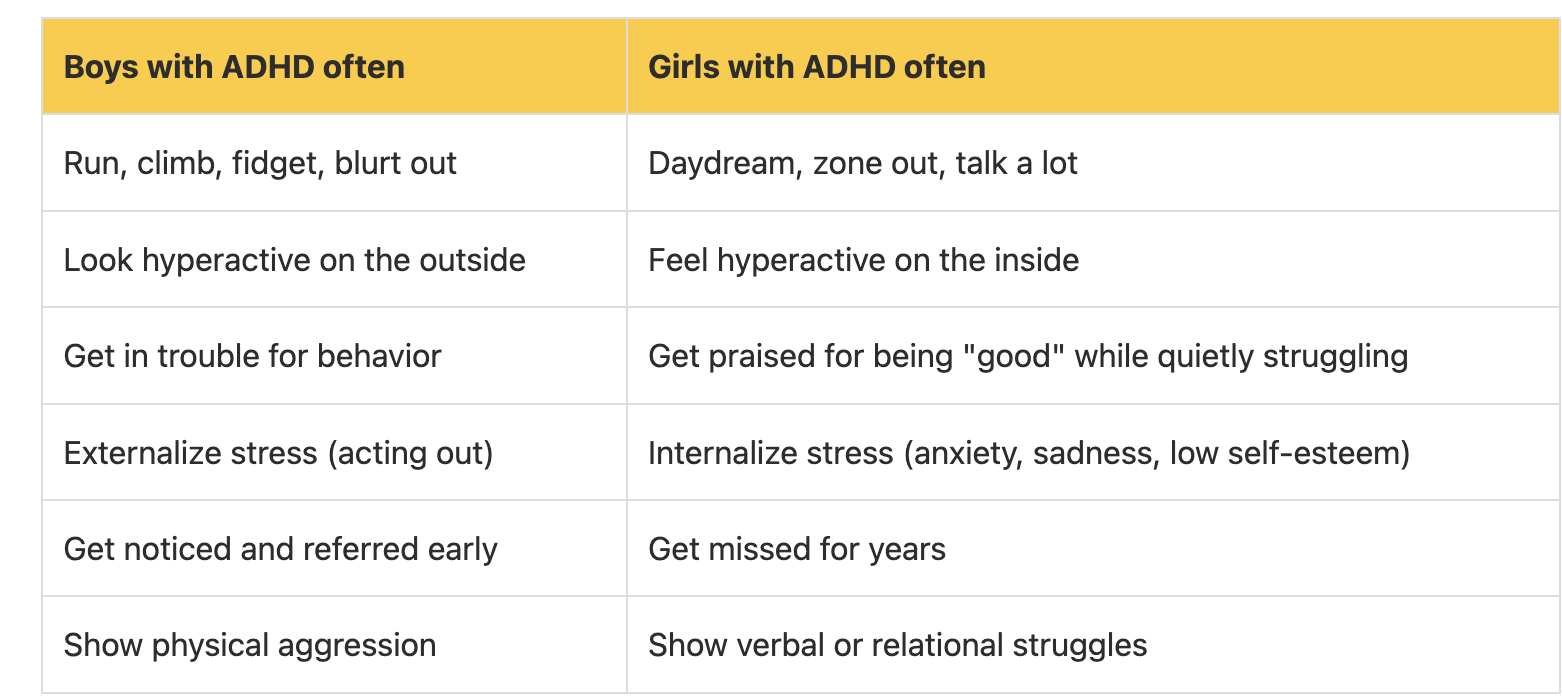
Researchers describe this as the difference between externalized and internalized symptoms. Boys' ADHD breaks the rules of the classroom. Girls' ADHD breaks them quietly from the inside.
Hyperactivity in girls can also show up as being hyper-verbal: nonstop talking, interrupting, jumping topics, narrating their thoughts out loud. It does not look like running across the room. It looks like big feelings, lots of words, and a lot going on under the surface.
Signs of ADHD in Girls (By Age)
Every child is different. Not every sign means ADHD. But if you see clusters of these patterns showing up across home, school, and friendships, it is worth a closer look.
Younger girls (ages 4 to 8)
Talks a lot, often interrupts, jumps from topic to topic
Big emotional reactions to small frustrations
Trouble following multi-step directions
Loses things often (jacket, homework, water bottle, shoes)
Gets bored easily but hyperfocuses on what she loves
Struggles with transitions, even fun ones
Daydreams during quiet activities
Says she feels "different" from her friends
Tween girls (ages 9 to 12)
Homework takes hours longer than it should
Reads the same page three times and still cannot remember it
Bedroom, backpack, and locker are constant chaos
Cries or shuts down when overwhelmed
Worries a lot about what other people think
Friend drama feels world-ending
Gets called "too sensitive," "too much," or "too dramatic"
Procrastinates, panics, then crashes
Says things like "I am stupid" or "Something is wrong with me"
Teen girls (ages 13 and up)
Grades start slipping in middle or high school as work gets harder
Symptoms get worse around her menstrual cycle
Anxiety, depression, or both show up
Sleep gets harder
Risky or impulsive choices show up
Feels exhausted from masking all day
Gets diagnosed with anxiety or depression first, while ADHD goes unnoticed
If you are nodding through more than a handful of these, you are not imagining things. You are paying attention. That matters.
Why Puberty Changes Everything for Girls With ADHD
This part rarely gets talked about, and it is one of the most important things parents of girls need to know.
ADHD symptoms in girls often get worse at puberty. Not because she stopped trying. Because her brain chemistry is shifting.
Here is the simple version. Estrogen helps the brain use dopamine, the chemical that supports focus, motivation, and mood.When estrogen drops, ADHD symptoms can spike. Add in progesterone, the menstrual cycle, school pressure, social pressure, and a body changing faster than her brain is ready for, and you have what one expert called "gasoline on a fire."
What that looks like in real life:
Symptoms that were manageable in elementary school suddenly explode in middle school
Mood swings around her cycle are bigger than her friends'
Anxiety and depression show up alongside ADHD
Treatment response can shift, and how her medication works may need to be revisited with her provider
She feels like she is failing for reasons she cannot name
Girls with ADHD are at higher risk for depression, anxiety, suicide attempts, risky sexual behavior, and substance use, beginning in adolescence. This is not to scare you. This is to make sure you take her struggles seriously when they show up, even if they show up looking like "she is just being a teenager."
She is not just being a teenager. She might be a teenager whose brain needs support.
ADHD Rarely Comes Alone
Nearly 78% of children with ADHD have at least one other co-occurring condition. In girls, the most common companions are:
Anxiety
Depression
Learning differences (especially in reading or math)
Sleep problems
Sensory sensitivities
Eating concerns
Low self-esteem
This is part of why girls' ADHD gets missed. The anxiety or sadness gets treated, while the underlying ADHD keeps fueling them both.
If your daughter is in therapy for anxiety and progress feels stuck, it can be worth opening a conversation with her provider about whether ADHD might also be part of the picture. Anxiety and ADHD often travel together, and a provider who knows your child can help you think through what to explore next.
Cultural implications of the ADHD Gap
Black girls are too often misread. Their hyperactivity gets labeled as "attitude." Their inattention gets labeled as "lazy." Their emotional intensity gets labeled as "grown and too much." They get punished where other girls get evaluated.
Research suggests racial and ethnic disparities in ADHD diagnosis and treatment exist. A national cohort study published in JAMA Network Open found Black, Hispanic, and Asian children were significantly less likely to be diagnosed with ADHD than White children, and White children were more likely to receive treatment. Other research indicates Black children are also less likely than White children to receive ADHD medication once diagnosed. Cultural stigma, provider bias, knowledge, and access gaps are among the factors researchers point to.
Your daughter deserves a full evaluation, not a label. If you suspect ADHD, push for it. Ask for a comprehensive assessment. Find a provider who sees your daughter as a whole child, not a stereotype. Black girls deserve the same care, curiosity, and support as any child.
What Actually Helps: Treatment Options for Girls With ADHD
Good news. ADHD is one of the most treatable conditions in children. Here is what current clinical guidelines support.
For girls under 6: Behavior therapy first
The American Academy of Pediatrics and the CDC both recommend parent training in behavior management as the first treatment for young children with ADHD, before medication. Younger children are more likely to have side effects from ADHD medication, and the CDC reports that parent training in behavior management works as well as medication for ADHD in young children, without the side effects.
What it looks like:
A licensed therapist trains parents in specific tools
Parents learn how to praise, redirect, and structure the day in ways that fit an ADHD brain
Evidence-based programs like Parent-Child Interaction Therapy (PCIT) are effective for this age
For girls ages 6 and up: Combined treatment
For older children, the AAP recommends a combination of behavior therapy and medication. Both pieces matter.
Behavior therapy options:
Behavioral Parent Training (BPT) for parents of school-age kids
Cognitive Behavioral Therapy (CBT) for emotional regulation, organization, and self-talk
School-based supports through a 504 plan or IEP
Executive function coaching for planning, time management, and organization
Medication options:
Stimulants (the most studied and most effective class for ADHD)
Non-stimulants (an option when stimulants are not a good fit)
Decisions about medication should always be made with a pediatrician, child psychiatrist, or developmental specialist who knows your child
Medication is not "giving up." It is one tool among many. Some families never use it. Some use it for a season. Some use it long-term. None of those choices makes you a better or worse parent. The goal is what helps your child function and feel okay in her own life.
Lifestyle pieces that support every treatment
These do not replace treatment, but they make it work better:
Consistent sleep (ADHD brains need more, not less)
Movement every day, ideally outside
Protein-forward breakfasts to steady energy
Predictable routines for mornings, homework, and bedtime
Limited screens, especially before bed
Connection time with you, even ten minutes a day, no agenda
What to Do If You Think Your Daughter Has ADHD
Here is your starter playbook.
Write it down. Keep a two-week log of what you notice at home. Bring it to your appointments.
Talk to her teacher. Ask if they see what you see. School observations matter for diagnosis.
Start with her pediatrician. Ask for a referral to a child psychologist, developmental pediatrician, or psychiatrist who evaluates ADHD.
Ask for a full evaluation. Not a quick screening. ADHD often shows up alongside anxiety, learning differences, and trauma, and a real evaluation looks at all of it.
Loop in the school. If she is diagnosed, ask about a 504 plan or IEP. These are not labels. These are scaffolding.
Take care of you, too. Parenting a child with ADHD is harder than the average parenting playbook prepares you for. You deserve support.
A Word Before You Go
Your daughter is not broken. She is not lazy. She is not "just being dramatic."
She has a brain that works differently. With the right support, she can be exactly who the CARE framework was built for: Curious, Adventurous, Resilient, and Emotionally Intelligent. ADHD does not cancel any of that. It just means the path looks a little different.
You are not failing. You are paying attention. That is the first thing your daughter needs.
The rest is a team effort, and you do not have to figure it out alone.
Every day is a great day to have a great day.
A note on this content
This blog post is educational and is not a substitute for therapy, evaluation, or medical care. If you are worried about your child, please connect with a licensed provider in your state. If your child is in crisis, call or text 988 (the Suicide and Crisis Lifeline) or go to your nearest emergency room.
Jennifer C. Williams, LCPC, PMH-C, is a licensed clinical professional counselor with 20 years of clinical practice and active licensure in Maryland, DC, Virginia, and Florida. She is the founder of SONshines and Playtime, a family lifestyle brand built around raising kids who CARE.
Sources
Centers for Disease Control and Prevention. (2024). Data and statistics on ADHD.cdc.gov/adhd/data
Centers for Disease Control and Prevention. (2024). Behavior therapy first for young children with ADHD.cdc.gov/adhd/articles
Centers for Disease Control and Prevention. (2024). Treatment of ADHD.cdc.gov/adhd/treatment
Cleveland Clinic. (2024). How are ADHD symptoms different in boys and girls?health.clevelandclinic.org
Coker, T. R., et al. (2016). Racial and ethnic disparities in ADHD diagnosis and treatment. Pediatrics, 138(3).additudemag.com
Eng, A. G., et al. (2024). Attention-deficit/hyperactivity disorder and the menstrual cycle: Theory and evidence. Hormones and Behavior, 158.sciencedirect.com
Mowlem, F. D., et al. (2019). Sex differences in predicting ADHD clinical diagnosis and pharmacological treatment. European Child & Adolescent Psychiatry.ncbi.nlm.nih.gov
Psychiatry Advisor. (2024). The prevalence of ADHD subtypes significantly differ by sex.psychiatryadvisor.com
Reuben, C., & Elgaddal, N. (2024). Attention-deficit/hyperactivity disorder in children ages 5-17 years: United States, 2020-2022 (NCHS Data Brief No. 499). National Center for Health Statistics.cdc.gov/nchs
Saul, M., & Saul, J. (2020). Attention-deficit/hyperactivity disorder predominantly inattentive subtype/presentation: Research progress and translational studies. Brain Sciences, 10(5), 292.ncbi.nlm.nih.gov
Shi, Y., et al. (2021). Racial disparities in diagnosis of attention-deficit/hyperactivity disorder in a US national birth cohort. JAMA Network Open, 4(3).ncbi.nlm.nih.gov
Skogli, E. W., et al. (2013). ADHD in girls and boys: Gender differences in co-existing symptoms and executive function measures. BMC Psychiatry, 13(298).ncbi.nlm.nih.gov
Understood. (2024). A guide to hormones and ADHD.understood.org
Young, S., et al. (2024). A systematic review and meta-analysis comparing the severity of core symptoms of ADHD in females and males. Psychological Medicine.cambridge.org