The Importance of Play: How Kids Actually Learn (And Why We Are Killing Childhood by Forgetting)
By Jennifer C. Williams, LCPC, PMH-C
Mind & Feelings
We have a play problem in this country.
Kids today have less unstructured play time than any generation in modern history. Recess is shrinking. Schedules are packed. Screens are everywhere. And parents are being told, sometimes from preschool on, that their child needs more academics, more lessons, more enrichment.
Here is what we know from decades of research: play is not a break from learning. Play IS learning.
The American Academy of Pediatrics has been sounding this alarm since 2007. Their most recent clinical report, The Power of Play, was reaffirmed in January 2025. The message has not changed: kids need to play. A lot. Every day. And it is not optional.
I want to break down WHY play matters so much, what kids actually learn from it, and what you can do at home to protect this critical piece of childhood.
Why Play Matters More Than You Think
Play is not just fun. It is how your child's brain literally builds itself.
When a child plays, especially in unstructured, open-ended ways, their brain is doing something remarkable. Neurons are firing. Connections are forming. Pathways for learning, regulation, and problem-solving are being laid down.
The American Academy of Pediatrics puts it bluntly: play enhances brain structure and function. It promotes something called executive function, which is the process of learning, not just the content. Executive function is what allows your kid to set a goal, ignore distractions, and follow through.
That is not a soft skill. That is the foundation of every academic and life success they will ever have.
And play is the way it gets built.
What Children Actually Learn From Play
This is where the magic happens. Let me walk through the specific developmental areas play strengthens.
1. Social-Emotional Skills
When kids play together, they are running a real-time experiment in human relationships.
They learn to:
Read facial expressions and tone
Take turns
Manage disappointment when they lose
Repair after a conflict
Negotiate the rules
Express what they need with words instead of fists
You cannot teach this in a workbook. It only develops through practice in unscripted social moments.
2. Language and Communication
Kids learn more vocabulary through play than through any flashcard.
Why? Because language during play has context. They are not memorizing the word "negotiate." They are LIVING it when they argue with their sibling about who gets to be the dragon.
Play forces kids to listen, observe, decipher meaning, and respond. It builds receptive language (understanding) and expressive language (talking) at the same time.
3. Executive Function
This is the big one.
Executive function includes three core skills:
Working memory (holding information in mind to use it)
Flexible thinking (shifting between ideas or rules)
Self-control (regulating impulses, paying attention)
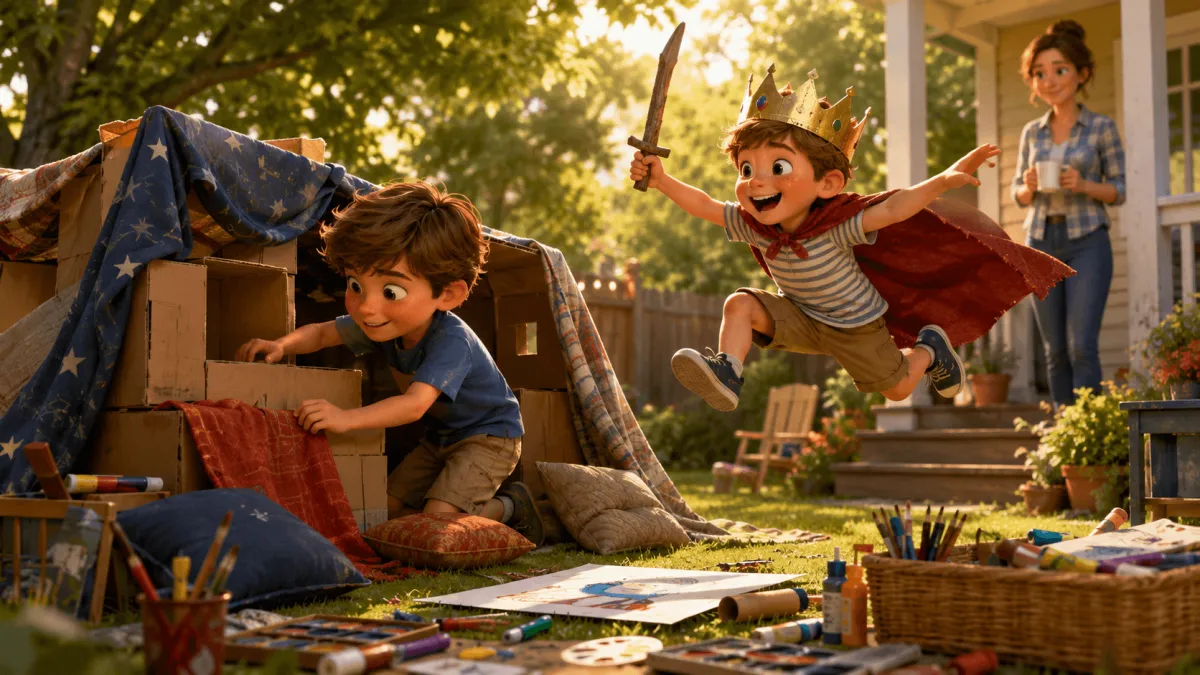
Pretend play is especially powerful here. When a kid pretends a stick is a sword, or that their stuffed animals are at a tea party, they are practicing all three skills at once. They are remembering the story they made up. Shifting between roles. Controlling their behavior to stay in character.
This kind of play directly predicts academic success more reliably than early reading drills.
4. Self-Regulation
When kids play, they regulate themselves without realizing it.
A child who plays alone with blocks for 30 minutes is practicing focus. A child who recovers from losing a board game is practicing emotional regulation. A child who waits patiently for their turn in tag is practicing impulse control.
These are the same skills your kid needs to sit through a math test, cope with a hard day at school, or handle a disagreement with a friend.
Play is regulation practice in disguise.
5. Problem Solving
In play, kids face problems constantly.
The tower keeps falling. The other kid does not want to play tag. The Lego piece is missing. The plan they had does not work.
In structured activities, adults often solve these problems for kids. In play, kids have to figure it out themselves. They try, fail, adjust, try again. They build resilience and creativity at the same time.
Every problem solved in play is a rep for problem-solving in real life.
6. Physical Development
Active play builds bodies. Climbing, running, balancing, throwing, catching. All of it strengthens muscles, coordination, and proprioception (your child's sense of where their body is in space).
Kids who get plenty of active play sleep better, eat better, and have better mood regulation.
7. Confidence and Identity
When a child gets absorbed in play, they discover what they love.
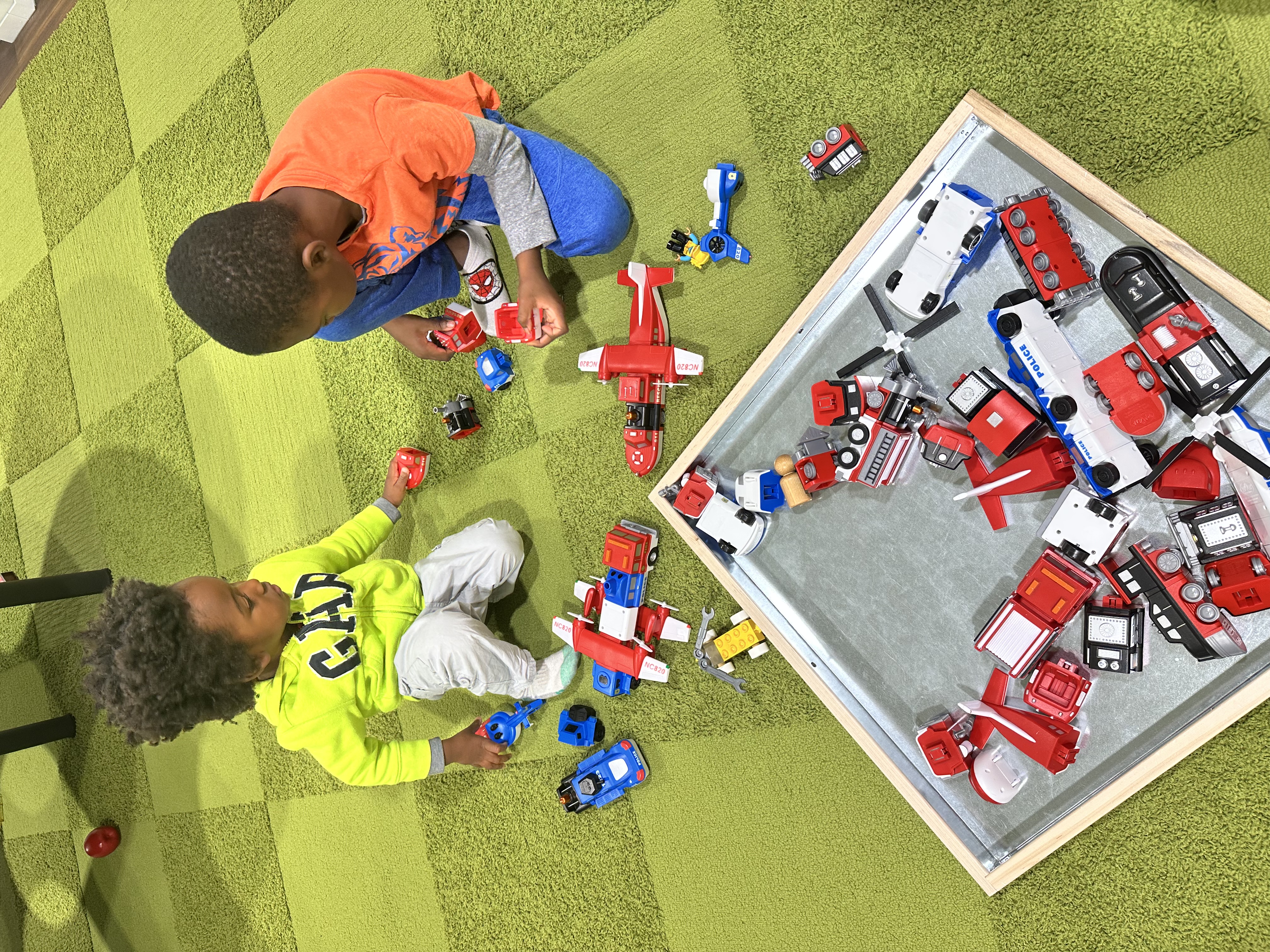
The kid who builds elaborate Lego cities is learning they are an engineer. The kid who plays restaurant for hours is learning they are a leader and a creator. The kid who organizes neighborhood games is learning they are a connector.
You cannot put this on a kindergarten worksheet. It only emerges through hours of unstructured exploration.
The Difference Between Play and "Enrichment"
This is a hard truth for a lot of parents.
A scheduled music lesson is not play. Soccer practice is not play. A homework worksheet disguised as a game is not play.
These activities have value. They teach specific skills. But they are not play.
Real play has 5 qualities:
Self-directed (the child chooses what to do)
Open-ended (no predetermined right answer)
Intrinsically motivated (done for the joy of it, not for a reward)
Process-focused (the doing matters more than the outcome)
Imaginative or active (involves creativity, movement, or both)
If an adult is directing every move, telling the kid the right way to do it, or rewarding only the correct outcome, it is instruction. Not play.
Kids need both. But they need way more play than most American children are currently getting.
The Modern Play Crisis
Here is what is happening in 2026:
Recess at many schools is 30 minutes or less
After-school time is packed with structured activities
Screens fill the "in-between" moments that used to be free play
Outdoor play has dropped sharply in the last 30 years
Pretend play in preschool is being replaced with academic instruction
The result? Anxiety in kids is rising. Attention problems are rising. Social skill gaps are widening.
These are not separate issues. They are connected. When you take away play, you take away the way kids build the skills they need to handle the rest of their lives.
The American Academy of Pediatrics is so concerned about this that they have officially recommended pediatricians prescribe play. Yes, you read that right. Doctors are writing "play prescriptions" because the loss of play has become a public health issue.
How to Bring More Play Back Into Your Home
You do not need to overhaul your life. Start with these realistic shifts.
1. Protect Daily Unstructured Time
Block 30 to 60 minutes of completely unscheduled time each day. No screens. No adult direction. Just space.
The first few days, your kid may say they are bored. Let them be bored. Boredom is the gateway to imagination.
2. Get Outside
Outdoor play hits a lot of developmental boxes at once: movement, sensory input, problem-solving, regulation, and exposure to nature.
Aim for at least one hour of outdoor time on most days, even in winter. A backyard counts. A walk in the neighborhood counts. A trip to the park counts.
3. Reduce Screen Time
Screen time is not play. Even "educational" screen time is consumption, not creation.
Set firm limits. Most kids need less screen time than they are currently getting. Use that reclaimed time for real play.
4. Stock the Right Toys
The best toys for play are simple, open-ended, and require imagination:
Blocks and building toys
Art supplies
Pretend play materials (dress up, kitchen, doctor kit)
Outdoor toys (bikes, balls, chalk)
Books for storytelling
Loose parts (cardboard boxes, fabric scraps, recycled materials)
Avoid toys that "do" everything for the child. The more passive the toy, the more active the child has to be.
5. Play With Them Sometimes
The AAP specifically highlights play between parents and children as critical for development. It is one of the most powerful tools for connection you have.
You do not need to play all day. But carve out time, even 15 minutes, to get on the floor and play whatever your child wants. Let them lead.
This is gold. This is the connection that buffers them against stress for the rest of their lives.
6. Resist Over-Scheduling
You do not have to enroll your child in every activity. Pick one or two structured activities they truly love. Protect the rest of their time for play, rest, and family.
A kid who is over-scheduled has no time to develop the inner skills that come from play. Less is often more.
7. Let Boredom Happen
When your child says "I'm bored," do not jump in to entertain them.
Boredom is a feature, not a bug. It is the discomfort that drives kids to create, invent, and engage. If you fill every moment, they never get to discover what they would have made if given the space.
Play for Different Ages
What play looks like changes as kids grow. Here is a quick guide.
Babies and Toddlers (0-3): Sensory play, exploration, movement, simple games like peek-a-boo. They are building the foundations of cognitive and motor development.
Preschoolers (3-5): Pretend play explodes here. Dress up, role play, imaginative scenarios. This is the most important phase for executive function development.
Elementary (6-10): Games with rules, collaborative play, outdoor adventures, building elaborate worlds (with Legos, forts, dolls, stuffed animals). Social-emotional skills deepen.
Tweens and Teens (11+): Yes, they still need play. It just looks different. Sports, creative projects, hanging out with friends, board games, video games (in moderation), making music, art. They are still building identity, regulation, and connection through chosen leisure activities.
The form changes. The need does not.
What This Means for Your Family
Your child is not behind because they had less screen time today.
Your child is not falling behind because they did not do an extra workbook.
Your child is not less prepared because you let them dig in the dirt instead of taking another enrichment class.
What your child needs to thrive is exactly what kids have always needed: love, safety, connection, and time to play.
Protect their play. Protect their imagination. Protect the unstructured time that lets them become who they are.
That is the gift.
Your Quick Action Plan
Audit your child's week: how much unstructured play do they actually get?
Block 30 to 60 minutes of daily unstructured play time
Reduce screen time to make room for real play
Stock your home with open-ended toys (blocks, art supplies, dress up)
Get outside at least an hour most days
Play WITH your child for 15 minutes a few times a week
Resist the urge to fill every moment of their schedule
When they say "I'm bored," respond with curiosity, not solutions
The Bottom Line
Play is not optional.
It is not a reward for finishing the real work. It IS the real work.
When kids play, they build the brain, the body, and the spirit they need to live a full life. We cannot afford to keep treating play like a luxury.
If you give your child one gift this year, give them this: time. Space. Permission to play.
That is the best investment you will ever make.
Did this article shift how you think about play?
If this helped you, share it with another parent who needs to hear it.
Sources
Yogman, M., Garner, A., Hutchinson, J., Hirsh-Pasek, K., Golinkoff, R. M., & American Academy of Pediatrics Committee on Psychosocial Aspects of Child and Family Health, Council on Communications and Media. (2018, reaffirmed January 2025). The Power of Play: A Pediatric Role in Enhancing Development in Young Children. Pediatrics, 142(3), e20182058. aappublications.org
American Academy of Pediatrics. (2025). Power of Play in Early Childhood. aap.org/power-of-play
Waters, G. M., Tidswell, G. R., & Bryant, E. J. (2022). Mothers' and fathers' views on the importance of play for their children's development. British Journal of Educational Psychology. ncbi.nlm.nih.gov